Benchmark
This guide documents the complete setup and results of benchmarking PostgreSQL RDS access from 10 global Fly.io regions through WireGuard overlay network.
Overview
The benchmark measures INSERT and SELECT latencies from Fly.io edge nodes to AWS RDS PostgreSQL in Ireland (eu-west-1), routing through an EC2 WireGuard hub.
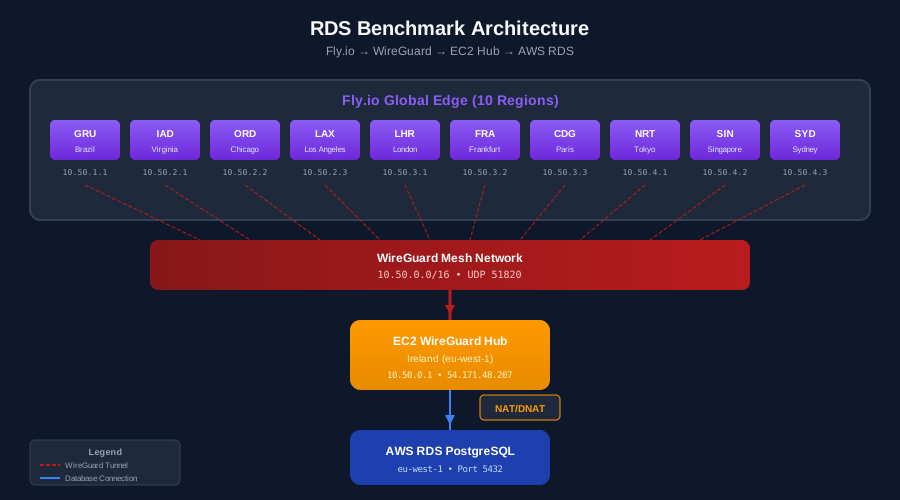
Benchmark Results
| Flag | Region | Location | Insert (ms) | Read (ms) | Rank |
|---|---|---|---|---|---|
| 🇬🇧 | lhr | London | 25.39 | 11.89 | 1 |
| 🇫🇷 | cdg | Paris | 37.61 | 18.48 | 2 |
| 🇩🇪 | fra | Frankfurt | 54.17 | 26.69 | 3 |
| 🇺🇸 | iad | Virginia | 173.16 | 86.10 | 4 |
| 🇺🇸 | ord | Chicago | 244.20 | 121.68 | 5 |
| 🇺🇸 | lax | Los Angeles | 285.52 | 138.19 | 6 |
| 🇸🇬 | sin | Singapore | 332.65 | 165.96 | 7 |
| 🇧🇷 | gru | Sao Paulo | 396.09 | 197.72 | 8 |
| 🇯🇵 | nrt | Tokyo | 523.35 | 261.36 | 9 |
| 🇦🇺 | syd | Sydney | 538.58 | 268.85 | 10 |
Visual Results

Key Insights
- London (LHR) has the best latency (~25ms INSERT, ~12ms READ) - closest to RDS in Ireland
- European regions (LHR, CDG, FRA) dominate top 3 due to geographic proximity
- US East Coast (IAD) ~173ms - crossing the Atlantic
- APAC regions (NRT, SYD) have highest latencies (~520-540ms) - maximum geographic distance
Step 1: Fly.io Backend Setup
1.1 Create the Go Backend
Create fly-backend/main.go:
package main

import (
    "database/sql"
    "encoding/json"
    "fmt"
    "net/http"
    "os"
    "strconv"
    "time"

    _ "github.com/lib/pq"
)

var (
    region   string
    hostname string
    db       *sql.DB
)

func main() {
    region = os.Getenv("FLY_REGION")
    if region == "" {
        region = "local"
    }

    hostname = os.Getenv("FLY_ALLOC_ID")
    if hostname == "" {
        hostname, _ = os.Hostname()
    }
    if len(hostname) > 8 {
        hostname = hostname[:8]
    }

    port := os.Getenv("PORT")
    if port == "" {
        port = "8080"
    }

    // Initialize database
    initDB()

    // RDS Benchmark endpoints
    http.HandleFunc("/api/rds/benchmark", handleRDSBenchmark)
    http.HandleFunc("/api/rds/health", handleRDSHealth)
    http.HandleFunc("/api/info", handleInfo)

    fmt.Printf("Backend running in region [%s] on port %s\n", region, port)
    http.ListenAndServe(":"+port, nil)
}

func getEnv(key, defaultValue string) string {
    if value := os.Getenv(key); value != "" {
        return value
    }
    return defaultValue
}

func initDB() {
    dbHost := getEnv("DB_HOST", "")
    if dbHost == "" {
        fmt.Println("DB_HOST not set, RDS benchmark disabled")
        return
    }

    dbPort := getEnv("DB_PORT", "5432")
    dbUser := getEnv("DB_USER", "postgres")
    dbPassword := getEnv("DB_PASSWORD", "")
    dbName := getEnv("DB_NAME", "contacts")

    connStr := fmt.Sprintf("host=%s port=%s user=%s password=%s dbname=%s sslmode=disable",
        dbHost, dbPort, dbUser, dbPassword, dbName)

    var err error
    db, err = sql.Open("postgres", connStr)
    if err != nil {
        fmt.Printf("Failed to open database: %v\n", err)
        return
    }

    db.SetMaxOpenConns(10)
    db.SetMaxIdleConns(5)
    db.SetConnMaxLifetime(time.Minute * 5)

    if err := db.Ping(); err != nil {
        fmt.Printf("Failed to ping database: %v\n", err)
        db = nil
        return
    }

    fmt.Printf("Database connected: %s\n", dbHost)
}

func handleRDSBenchmark(w http.ResponseWriter, r *http.Request) {
    w.Header().Set("Content-Type", "application/json")
    w.Header().Set("X-Fly-Region", region)

    dbHost := getEnv("DB_HOST", "not configured")

    if db == nil {
        json.NewEncoder(w).Encode(map[string]interface{}{
            "error":   "Database not configured",
            "region":  region,
            "db_host": dbHost,
        })
        return
    }

    iterations := 10
    if iter := r.URL.Query().Get("iterations"); iter != "" {
        if n, err := strconv.Atoi(iter); err == nil && n > 0 && n <= 100 {
            iterations = n
        }
    }

    readLatencies := make([]float64, iterations)
    insertLatencies := make([]float64, iterations)

    // Run READ benchmarks (SELECT COUNT)
    for i := 0; i < iterations; i++ {
        start := time.Now()
        var count int
        db.QueryRow("SELECT COUNT(*) FROM contacts").Scan(&count)
        readLatencies[i] = float64(time.Since(start).Microseconds()) / 1000.0
    }

    // Run INSERT benchmarks
    for i := 0; i < iterations; i++ {
        start := time.Now()
        name := fmt.Sprintf("Bench-%s-%d-%d", region, time.Now().UnixNano(), i)
        email := fmt.Sprintf("bench-%d@test.local", time.Now().UnixNano())
        db.Exec(`INSERT INTO contacts (name, email, notes) VALUES ($1, $2, $3)`,
            name, email, "Benchmark")
        insertLatencies[i] = float64(time.Since(start).Microseconds()) / 1000.0
    }

    // Calculate statistics
    calcStats := func(latencies []float64) (avg, min, max float64) {
        if len(latencies) == 0 {
            return 0, 0, 0
        }
        min = latencies[0]
        max = latencies[0]
        var sum float64
        for _, l := range latencies {
            sum += l
            if l < min {
                min = l
            }
            if l > max {
                max = l
            }
        }
        avg = sum / float64(len(latencies))
        return
    }

    readAvg, readMin, readMax := calcStats(readLatencies)
    insertAvg, insertMin, insertMax := calcStats(insertLatencies)

    result := map[string]interface{}{
        "region":           region,
        "db_host":          dbHost,
        "iterations":       iterations,
        "read_avg_ms":      readAvg,
        "read_min_ms":      readMin,
        "read_max_ms":      readMax,
        "insert_avg_ms":    insertAvg,
        "insert_min_ms":    insertMin,
        "insert_max_ms":    insertMax,
        "read_latencies":   readLatencies,
        "insert_latencies": insertLatencies,
        "timestamp":        time.Now().UTC().Format(time.RFC3339),
    }

    json.NewEncoder(w).Encode(result)
}

func handleRDSHealth(w http.ResponseWriter, r *http.Request) {
    w.Header().Set("Content-Type", "application/json")

    result := map[string]interface{}{
        "region":  region,
        "db_host": getEnv("DB_HOST", "not configured"),
    }

    if db == nil {
        result["status"] = "disabled"
    } else if err := db.Ping(); err != nil {
        result["status"] = "error"
        result["message"] = err.Error()
    } else {
        result["status"] = "connected"
    }

    json.NewEncoder(w).Encode(result)
}

func handleInfo(w http.ResponseWriter, r *http.Request) {
    w.Header().Set("Content-Type", "application/json")

    json.NewEncoder(w).Encode(map[string]interface{}{
        "region":   region,
        "hostname": hostname,
    })
}
1.2 Create go.mod
module fly-backend

go 1.21

require github.com/lib/pq v1.10.9
1.3 Create Dockerfile
FROM golang:1.21-alpine AS builder
WORKDIR /app
COPY go.mod go.sum ./
RUN go mod download
COPY main.go .
RUN CGO_ENABLED=0 GOOS=linux go build -ldflags="-s -w" -o backend main.go
FROM alpine:3.19
RUN apk --no-cache add ca-certificates wireguard-tools iptables ip6tables iproute2 bash
WORKDIR /app
COPY /app/backend .
COPY entrypoint.sh .
RUN chmod +x entrypoint.sh
CMD ["./entrypoint.sh"]
1.4 Create entrypoint.sh (WireGuard + Backend)
#!/bin/bash
set -e

echo "=== Starting WireGuard + Backend ==="
echo "FLY_REGION: ${FLY_REGION}"

# EC2 endpoint and public key (hub)
EC2_ENDPOINT="54.171.48.207:51820"
EC2_PUBKEY="bzM6rw/efq+75VGhBgkCRChDnKfFlXQY560ejhvKCQY="

# Map region to WireGuard IP and private key
case "${FLY_REGION}" in
  gru)
    WG_IP="10.50.1.1/32"
    WG_PRIVATE="YOUR_GRU_PRIVATE_KEY"
    ;;
  iad)
    WG_IP="10.50.2.1/32"
    WG_PRIVATE="YOUR_IAD_PRIVATE_KEY"
    ;;
  ord)
    WG_IP="10.50.2.2/32"
    WG_PRIVATE="YOUR_ORD_PRIVATE_KEY"
    ;;
  lax)
    WG_IP="10.50.2.3/32"
    WG_PRIVATE="YOUR_LAX_PRIVATE_KEY"
    ;;
  lhr)
    WG_IP="10.50.3.1/32"
    WG_PRIVATE="YOUR_LHR_PRIVATE_KEY"
    ;;
  fra)
    WG_IP="10.50.3.2/32"
    WG_PRIVATE="YOUR_FRA_PRIVATE_KEY"
    ;;
  cdg)
    WG_IP="10.50.3.3/32"
    WG_PRIVATE="YOUR_CDG_PRIVATE_KEY"
    ;;
  nrt)
    WG_IP="10.50.4.1/32"
    WG_PRIVATE="YOUR_NRT_PRIVATE_KEY"
    ;;
  sin)
    WG_IP="10.50.4.2/32"
    WG_PRIVATE="YOUR_SIN_PRIVATE_KEY"
    ;;
  syd)
    WG_IP="10.50.4.3/32"
    WG_PRIVATE="YOUR_SYD_PRIVATE_KEY"
    ;;
  *)
    echo "Unknown region: ${FLY_REGION}, skipping WireGuard"
    exec ./backend
    ;;
esac

echo "Configuring WireGuard with IP: ${WG_IP}"

# Create WireGuard configuration
mkdir -p /etc/wireguard

cat > /etc/wireguard/wg0.conf << WGEOF
[Interface]
PrivateKey = ${WG_PRIVATE}
Address = ${WG_IP}

[Peer]
# EC2 Ireland (hub)
PublicKey = ${EC2_PUBKEY}
Endpoint = ${EC2_ENDPOINT}
AllowedIPs = 10.50.0.0/24, 10.50.1.0/24, 10.50.2.0/24, 10.50.3.0/24, 10.50.4.0/24
PersistentKeepalive = 25
WGEOF

# Start WireGuard
echo "Starting WireGuard interface..."
wg-quick up wg0 || echo "WireGuard failed (might need NET_ADMIN capability)"

# Show status
wg show || true

echo "Starting backend server..."
exec ./backend
1.5 Create fly.toml
app = 'edgeproxy-backend'
primary_region = 'gru'

[build]

[http_service]
  internal_port = 8080
  force_https = true
  auto_stop_machines = 'stop'
  auto_start_machines = true
  min_machines_running = 0
  processes = ['app']

[[vm]]
  memory = '256mb'
  cpu_kind = 'shared'
  cpus = 1
Step 2: Deploy to Fly.io
2.1 Create the app
fly apps create edgeproxy-backend
2.2 Set database secrets
fly secrets set \
  DB_HOST=10.50.0.1 \
  DB_PORT=5432 \
  DB_USER=contacts_user \
  DB_PASSWORD=your_password \
  DB_NAME=contacts \
  -a edgeproxy-backend
2.3 Deploy to all regions
# Deploy the app
fly deploy

# Scale to all 10 regions
fly scale count 1 --region gru,iad,ord,lax,lhr,fra,cdg,nrt,sin,syd -a edgeproxy-backend
Step 3: AWS RDS Setup
3.1 Create RDS Instance
aws rds create-db-instance \
  --db-instance-identifier edgeproxy-db \
  --db-instance-class db.t3.micro \
  --engine postgres \
  --engine-version 15.4 \
  --master-username postgres \
  --master-user-password YOUR_PASSWORD \
  --allocated-storage 20 \
  --vpc-security-group-ids sg-xxxxxxxx \
  --availability-zone eu-west-1a \
  --publicly-accessible \
  --no-multi-az
3.2 Disable SSL Requirement
Create a custom parameter group:
aws rds create-db-parameter-group \
  --db-parameter-group-name edgeproxy-nossl \
  --db-parameter-group-family postgres15 \
  --description "Disable SSL for WireGuard connections"

aws rds modify-db-parameter-group \
  --db-parameter-group-name edgeproxy-nossl \
  --parameters "ParameterName=rds.force_ssl,ParameterValue=0,ApplyMethod=pending-reboot"

aws rds modify-db-instance \
  --db-instance-identifier edgeproxy-db \
  --db-parameter-group-name edgeproxy-nossl \
  --apply-immediately

aws rds reboot-db-instance --db-instance-identifier edgeproxy-db
3.3 Create Database and Table
CREATE DATABASE contacts;

\c contacts

CREATE TABLE contacts (
    id SERIAL PRIMARY KEY,
    name VARCHAR(255) NOT NULL,
    email VARCHAR(255),
    notes TEXT,
    created_at TIMESTAMP DEFAULT CURRENT_TIMESTAMP
);

CREATE USER contacts_user WITH PASSWORD 'your_password';
GRANT ALL PRIVILEGES ON DATABASE contacts TO contacts_user;
GRANT ALL PRIVILEGES ON ALL TABLES IN SCHEMA public TO contacts_user;
GRANT USAGE, SELECT ON ALL SEQUENCES IN SCHEMA public TO contacts_user;
Step 4: EC2 WireGuard Hub Configuration
4.1 EC2 User Data (cloud-init)
#!/bin/bash
set -e

# Install WireGuard
apt-get update && apt-get install -y wireguard

# Enable IP forwarding
echo "net.ipv4.ip_forward = 1" >> /etc/sysctl.conf
sysctl -p

# Generate WireGuard keys
wg genkey | tee /etc/wireguard/privatekey | wg pubkey > /etc/wireguard/publickey
PRIVATE_KEY=$(cat /etc/wireguard/privatekey)

# Create WireGuard config
cat > /etc/wireguard/wg0.conf << 'EOF'
[Interface]
PrivateKey = PRIVATE_KEY_HERE
Address = 10.50.0.1/24
ListenPort = 51820
PostUp = iptables -t nat -A POSTROUTING -o ens5 -j MASQUERADE
PostDown = iptables -t nat -D POSTROUTING -o ens5 -j MASQUERADE

# Fly.io peers (add after generating their keys)
[Peer]
# fly-gru-1
PublicKey = FLY_GRU_PUBKEY
AllowedIPs = 10.50.1.1/32

[Peer]
# fly-iad-1
PublicKey = FLY_IAD_PUBKEY
AllowedIPs = 10.50.2.1/32

# ... add all 10 regions
EOF

# Replace placeholder
sed -i "s|PRIVATE_KEY_HERE|$PRIVATE_KEY|" /etc/wireguard/wg0.conf

# Start WireGuard
systemctl enable wg-quick@wg0
systemctl start wg-quick@wg0

# DNAT for RDS access (route 10.50.0.1:5432 to RDS)
RDS_IP="172.31.x.x"  # Your RDS private IP
iptables -t nat -A PREROUTING -d 10.50.0.1 -p tcp --dport 5432 -j DNAT --to-destination $RDS_IP:5432
iptables -t nat -A POSTROUTING -d $RDS_IP -p tcp --dport 5432 -j MASQUERADE
4.2 Security Group Rules
EC2 Security Group:
- Inbound: UDP 51820 from 0.0.0.0/0 (WireGuard)
- Inbound: TCP 22 from your IP (SSH)
- Outbound: All traffic
RDS Security Group:
- Inbound: TCP 5432 from EC2 Security Group
- Inbound: TCP 5432 from EC2 private IP
Step 5: Running the Benchmark
5.1 Test from EC2 (via WireGuard)
# Test each backend directly
for backend in "gru:10.50.1.1" "iad:10.50.2.1" "lhr:10.50.3.1"; do
  region=$(echo $backend | cut -d: -f1)
  ip=$(echo $backend | cut -d: -f2)
  echo "=== $region ==="
  curl -s http://$ip:8080/api/rds/benchmark | jq '{region, insert_avg_ms, read_avg_ms}'
done
5.2 Test via edgeProxy (geo-routing)
# The edge-proxy will route based on client IP
curl -s http://54.171.48.207:8080/api/rds/benchmark | jq .
5.3 Full Benchmark Script
#!/bin/bash
echo "=== RDS Benchmark: Fly.io → AWS RDS Ireland ==="
echo ""
printf "| %-4s | %-6s | %-13s | %-11s | %-9s |\n" "Flag" "Region" "Location" "Insert (ms)" "Read (ms)"
echo "|------|--------|---------------|-------------|-----------|"

for backend in \
  "🇧🇷:gru:10.50.1.1:Sao Paulo" \
  "🇺🇸:iad:10.50.2.1:Virginia" \
  "🇺🇸:ord:10.50.2.2:Chicago" \
  "🇺🇸:lax:10.50.2.3:Los Angeles" \
  "🇬🇧:lhr:10.50.3.1:London" \
  "🇩🇪:fra:10.50.3.2:Frankfurt" \
  "🇫🇷:cdg:10.50.3.3:Paris" \
  "🇯🇵:nrt:10.50.4.1:Tokyo" \
  "🇸🇬:sin:10.50.4.2:Singapore" \
  "🇦🇺:syd:10.50.4.3:Sydney"
do
  flag=$(echo $backend | cut -d: -f1)
  region=$(echo $backend | cut -d: -f2)
  ip=$(echo $backend | cut -d: -f3)
  location=$(echo $backend | cut -d: -f4)

  result=$(curl -s --connect-timeout 10 http://$ip:8080/api/rds/benchmark 2>/dev/null)

  if [ -n "$result" ]; then
    insert=$(echo $result | jq -r '.insert_avg_ms' | xargs printf "%.2f")
    read=$(echo $result | jq -r '.read_min_ms' | xargs printf "%.2f")
    printf "| %-4s | %-6s | %-13s | %11s | %9s |\n" "$flag" "$region" "$location" "$insert" "$read"
  else
    printf "| %-4s | %-6s | %-13s | %11s | %9s |\n" "$flag" "$region" "$location" "TIMEOUT" "TIMEOUT"
  fi
done
API Reference
GET /api/rds/benchmark
Runs INSERT and SELECT benchmarks against the configured RDS database.
Query Parameters:
iterations(optional): Number of iterations (1-100, default: 10)
Response:
{
  "region": "lhr",
  "db_host": "10.50.0.1",
  "iterations": 10,
  "read_avg_ms": 18.72,
  "read_min_ms": 11.89,
  "read_max_ms": 65.45,
  "insert_avg_ms": 25.39,
  "insert_min_ms": 24.60,
  "insert_max_ms": 29.04,
  "read_latencies": [65.45, 12.10, 11.99, ...],
  "insert_latencies": [24.97, 25.62, 24.60, ...],
  "timestamp": "2025-12-07T15:48:02Z"
}
GET /api/rds/health
Returns database connection status.
Response:
{
  "region": "lhr",
  "db_host": "10.50.0.1",
  "status": "connected"
}
Troubleshooting
Issue: "no pg_hba.conf entry for host"
Cause: RDS requires SSL by default.
Solution: Disable SSL requirement:
aws rds modify-db-parameter-group \
  --db-parameter-group-name edgeproxy-nossl \
  --parameters "ParameterName=rds.force_ssl,ParameterValue=0,ApplyMethod=pending-reboot"
Issue: Connection timeout from Fly.io
Cause: WireGuard not connecting to EC2 hub.
Solution:
- Verify EC2 public key matches in entrypoint.sh
- Check EC2 security group allows UDP 51820
- Verify NAT rules on EC2:
iptables -t nat -L -n -v
Issue: "Database not configured" response
Cause: DB_HOST secret not set.
Solution:
fly secrets set DB_HOST=10.50.0.1 -a edgeproxy-backend
WireGuard IP Allocation
| Region | Fly.io WG IP | Purpose |
|---|---|---|
| EC2 Hub | 10.50.0.1 | WireGuard hub + NAT to RDS |
| gru | 10.50.1.1 | South America |
| iad | 10.50.2.1 | US East |
| ord | 10.50.2.2 | US Central |
| lax | 10.50.2.3 | US West |
| lhr | 10.50.3.1 | Europe (UK) |
| fra | 10.50.3.2 | Europe (Germany) |
| cdg | 10.50.3.3 | Europe (France) |
| nrt | 10.50.4.1 | Asia (Japan) |
| sin | 10.50.4.2 | Asia (Singapore) |
| syd | 10.50.4.3 | Oceania (Australia) |
Performance Optimization Tips
-
Use connection pooling: The Go backend uses
SetMaxOpenConns(10)andSetMaxIdleConns(5) -
Persistent connections: WireGuard
PersistentKeepalive = 25keeps tunnels warm -
Place RDS in same region as hub: EC2 and RDS in eu-west-1 minimizes internal latency
-
Consider read replicas: For read-heavy workloads, deploy RDS read replicas in other regions